
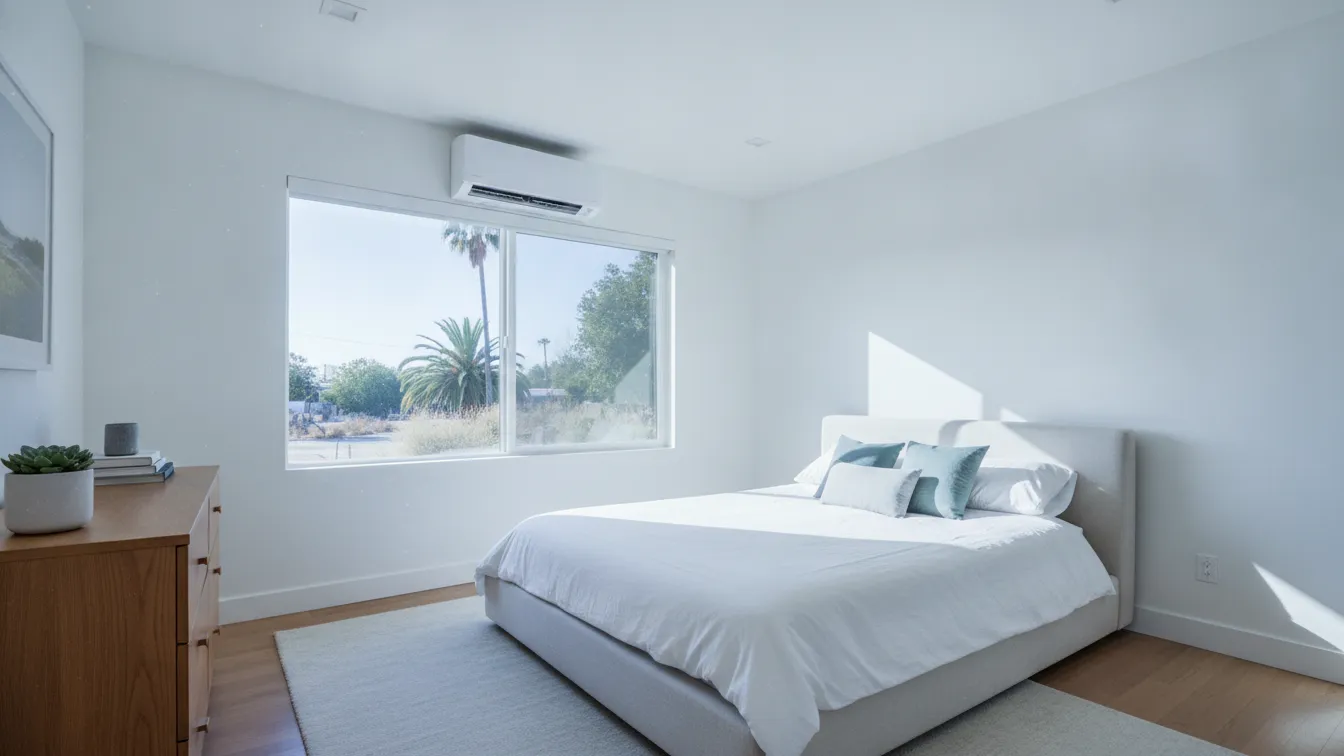
Mini split or central air
The ducts you already have, or do not have, decide most of this choice. Here is how the two compare in a Los Angeles house.
Updated September 2026 by the Air Cove HVAC team
If the house already has good ducts, central air is usually the answer, and if it has none, a mini split usually is.
Central air cools the whole house from one system. It pushes cooled air through ducts to a register in each room. A ductless mini split puts a small indoor unit, called a head, in each room or open area, and runs a thin line set from each head to an outdoor unit. No ducts are needed.
Both cool well. Both can heat, since a mini split is usually a heat pump and central air can be paired with a furnace or built as a heat pump. The real difference is the ducts, and how many rooms you want to control. We cover homes across Los Angeles, and our page on ductless mini split installation explains how we plan a ductless system room by room.
How they compare
Here is how the two line up side by side.
| What matters | Mini split | Central air |
|---|---|---|
| Ducts | Not needed | Needed, and they must be in good shape |
| Control | Each room or area set on its own | One setting for the house, unless it is zoned |
| Looks | A head on the wall or ceiling in each room | Registers in the ceiling or floor |
| Noise inside | Very quiet heads, with the compressor outside | Quiet, with some air noise at the registers |
| Energy losses | No duct losses | Leaky ducts in a hot attic can waste cooling |
| Filters | A filter in each head to rinse | One filter at the return |
| Best fit | No ducts, an addition, one or two hot rooms | A house with sound ducts that needs whole-house cooling |
Houses with ducts, and houses without
If the house has ducts. Start by checking them. Good ducts make central air the simplest, tidiest way to cool the whole house, with one outdoor unit and nothing on the walls. Leaking or crushed ducts change the picture. Under California's Title 24 energy code, a new central system usually brings an independent HERS test of the ducts, and existing ducts usually need to test at 15 percent leakage or better. If they fail, sealing or replacing them becomes part of the job. Sometimes duct repair and sealing is all it takes. Sometimes the ducts are far enough gone that a mini split makes more sense.
If the house has no ducts. Many older Los Angeles homes were built with a wall furnace and no duct system at all. Adding ducts means finding room for them in the attic, the crawl space or dropped ceilings. A mini split skips that. The line sets are small and can run through an outside wall, an attic or a closet, so the house stays largely as it is.
If you only need one or two rooms. An upstairs bedroom that bakes in the afternoon, a converted garage or an addition the ducts never reached is a classic mini split job, even in a house with central air.
Why the answer is different in Los Angeles
Attic ducts in the valleys. Many Los Angeles houses run their ducts through the attic. In Woodland Hills, Van Nuys or Santa Clarita, that attic can get very hot on summer afternoons. A leaking duct up there loses cooling before it reaches the room. A mini split has no ducts to leak, which is one reason it does well inland.
Mild winters. Both systems can heat, and in a Los Angeles winter a mini split usually heats the rooms it serves comfortably without backup.
The same rules apply. Installing heating and cooling equipment usually goes through your city's building department, and we handle the permit where one is needed. New equipment made since 2025 mainly runs on R-454B or R-32, for both kinds of system. Check the current rebates at LADWP, SCE or SoCalGas before you buy.
The decision you are making
You are choosing between cooling the whole house from one system and cooling it room by room. The questions that decide it are these.
- Does the house have ducts, and are they worth keeping?
- How many rooms do you want to cool, and do you use them all at once?
- Do you mind a head on the wall in each room?
- Is the furnace old enough that a heat pump should replace it too?
To help you decide, we look at the ducts if there are any, the rooms, the attic, the electrical panel and where an outdoor unit can sit. Then we price the option that fits, and the other one if you want to compare. Our guide to mini split installation cost covers what moves the price of a ductless system, and our page on AC installation and replacement covers central air. When the ductless route fits, our ductless mini split installation page is the place to start.
Mini split or central air questions
How many mini splits do I need for a 2000 square foot house?
It depends on the rooms, not the square feet. You need a head in each room or open area you want to control. A house with an open living area and three bedrooms might need a head for the living area and one for each bedroom. We walk the house, look at the sun and the layout and size each head to its room.
Are mini splits cheaper to run than central air?
They can be. A mini split has no duct losses, and you only cool the rooms you are using. Central air on tight, well-sealed ducts is efficient too. The gap is widest where the old ducts leak into a hot attic.
Can I have both?
Yes. Plenty of houses keep central air for the main floor and add a mini split for a room it cannot keep cool, such as an addition or a converted garage.
Not sure which system fits your house? Tell us about the rooms and whether there are ducts.

Find the right system for your house
Call us, or send the form and we will call you back to set up a visit anywhere across Los Angeles.