
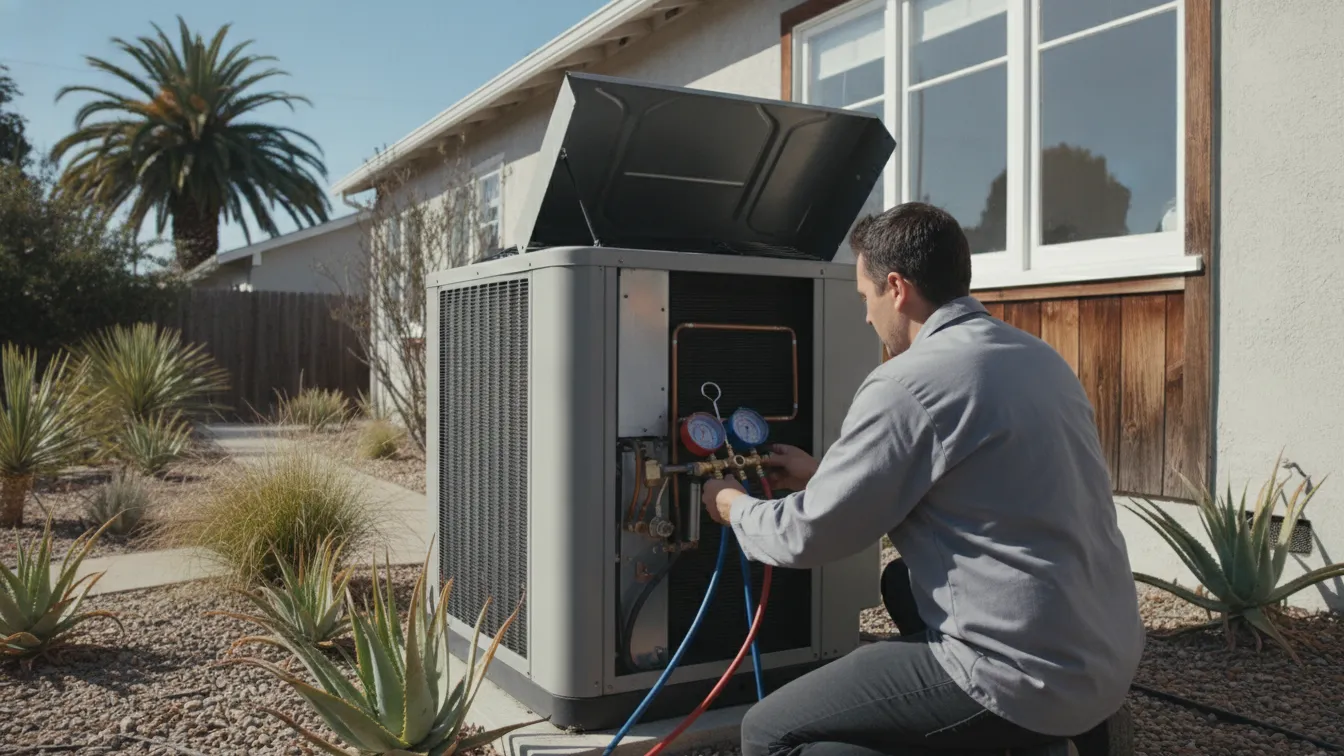
AC repair in Los Angeles
Warm air, a system that runs and runs, or one that will not start. We find the fault first, then tell you what it takes to fix.
When the air conditioner blows warm, runs nonstop or will not start, we find the fault first.
Then we explain it in plain words and give you the price before any work starts. No part gets replaced on a guess.
We repair central air conditioners, heat pumps in cooling mode and ductless systems in homes across Los Angeles, from Santa Monica and the Westside to the San Fernando and Santa Clarita valleys, Pasadena, Glendale and the South Bay. If you are not sure the problem is the air conditioner at all, start with all our heating and cooling services and we will help you narrow it down.
What the symptom usually means
Most AC trouble shows up as one of a handful of symptoms. Each one points us to a short list of causes, and we test those first.
Blowing warm air
A tripped breaker, a failed capacitor, a dead outdoor fan motor or low refrigerant from a leak. Our guide to AC blowing warm air covers what you can check yourself first.
Will not start
No power at the disconnect, a failed contactor, a thermostat that has lost its settings or its power, or a safety switch that has shut the system down.
Water at the indoor unit
A blocked condensate drain or a failed condensate pump. Left alone, it can soak a ceiling or a closet floor.
Ice on the lines or coil
Usually restricted airflow from a clogged filter or a failing blower, or refrigerant running low. Turn the system off and let it thaw before it runs again.
Runs all day, never cools
An undersized or dirty coil, leaking ducts, low refrigerant, or a system that has simply reached the end of its useful life.
Loud or new noises
A buzzing contactor, a humming motor that will not turn, a rattle from a loose panel or a squeal from a worn fan bearing.
The repairs an air conditioner usually needs
Most air conditioner repairs come down to one worn part. These are routine repairs.
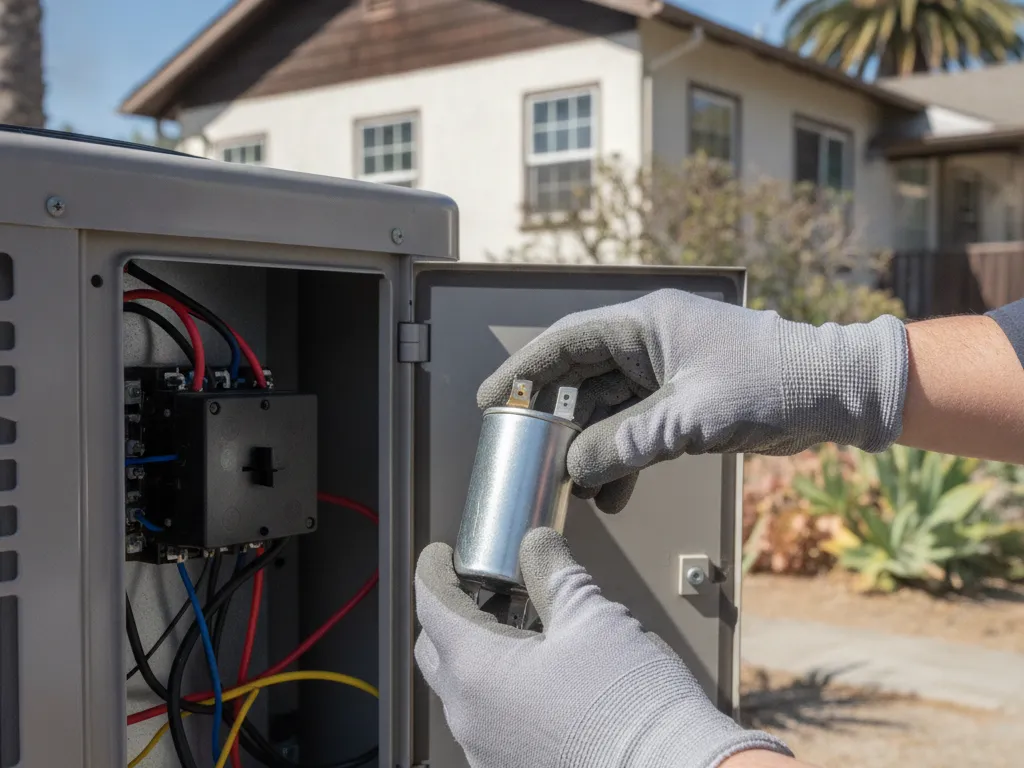
- Capacitors and contactors. The parts that start the compressor and fan. When they fail, the outdoor unit hums or does nothing at all.
- Fan motors. Indoor blower and outdoor fan motors wear out, and a weak one can freeze the coil or overheat the compressor.
- Refrigerant leaks. Adding refrigerant without finding the leak only buys a few weeks. We find the leak, and then you decide whether to repair it.
- Drains and pumps. Clearing a clogged condensate line or replacing a failed pump.
- Controls and wiring. Thermostats, safety switches, fuses and the low-voltage wiring between the indoor and outdoor units.
A failed compressor or a leaking evaporator coil is a bigger decision, because the repair can approach the cost of a new system. Our guide to AC repair cost walks through which repairs are small and which are not.
Repair or replace
We will tell you when a repair no longer makes sense, and why. The questions we weigh with you:
- How old is the system? Central air conditioners commonly last somewhere around fifteen years, and less where they work hardest in the inland valleys.
- What does the repair cost against the value left in the system? A common rule of thumb multiplies the age of the unit by the repair cost. If the answer is above 5,000, replacement is usually worth pricing.
- What refrigerant does it use? Most systems installed before 2025 run on R-410A. New equipment now uses R-454B or R-32. We can still repair and recharge an R-410A system, but a big refrigerant repair on an older unit is often the point where replacement makes more sense.
- Is the rest of the system sound? Leaking ducts or a worn furnace blower can make a new outdoor unit perform badly.
If replacement is the better answer, our AC installation and replacement page explains what that involves in Los Angeles, from the permit to the final test. If the repair makes sense, we make it.
What the visit looks like
We keep it simple and we keep you informed.
You call or send the form
Tell us what the system is doing, how old it is if you know, and whether it is the indoor or the outdoor unit that seems wrong. A photo of the label on the outdoor unit helps.
We diagnose before we replace anything
We check power, controls, airflow and refrigerant pressures, and we find the part that failed and why it failed.
You get the fault and the price
We explain what we found and what it costs to fix. If there is more than one way to solve it, we tell you the choices.
We fix it and test it
After the repair we run the system and check that it is cooling properly before we leave.
Why call Air Cove HVAC
We know which parts fail on which systems and what a failed part does to the rest of the system. We are licensed and insured, and we work seven days a week, every day, 7 a.m. to 11 p.m. If a repair is not worth it, we say so. Keeping a failing system on life support with repeat refrigerant top-ups is not a repair.
Regular care is the cheapest way to avoid a breakdown on the hottest day of the year. AC tune-ups and maintenance catch worn capacitors, dirty coils and slow leaks early.
AC repair questions
What is the most common AC problem?
Failed start components. A worn capacitor or contactor stops the compressor or the outdoor fan from starting, and the system blows warm air. Clogged filters and blocked drains come close behind. All of them are quick repairs once they are found.
What is the $5000 rule for AC?
It is a rule of thumb for repair or replace. Multiply the age of the system in years by the repair price. If the result is above 5,000, replacing the system is usually worth pricing. It is a starting point, not a verdict, and we look at the refrigerant, the condition of the rest of the system and how the house is used before we recommend either.
What is the 3 minute rule for AC?
After an air conditioner shuts off, give it about three minutes before it starts again, so the pressures inside can settle and the compressor is not forced to start under load. Most modern thermostats build in this delay. If you switch the system off and on to reset it, wait the same three minutes.
What is the average cost of an AC service call?
It depends on what the call finds. We find the fault first and tell you what the repair costs before we start, so you can decide. We tell you what the repair costs before we do it, so you can decide.
Do I need to be home for the repair?
Someone needs to be home to let us in and to agree on the repair once we have found the fault. The outdoor unit is often all we need, but most repairs also mean checking the thermostat and the indoor unit.
Air conditioner not keeping up? Tell us what it is doing and we will find the fault.

Get your air conditioning back
Call us, or send the form and we will call you back. We work across Los Angeles, seven days a week.