
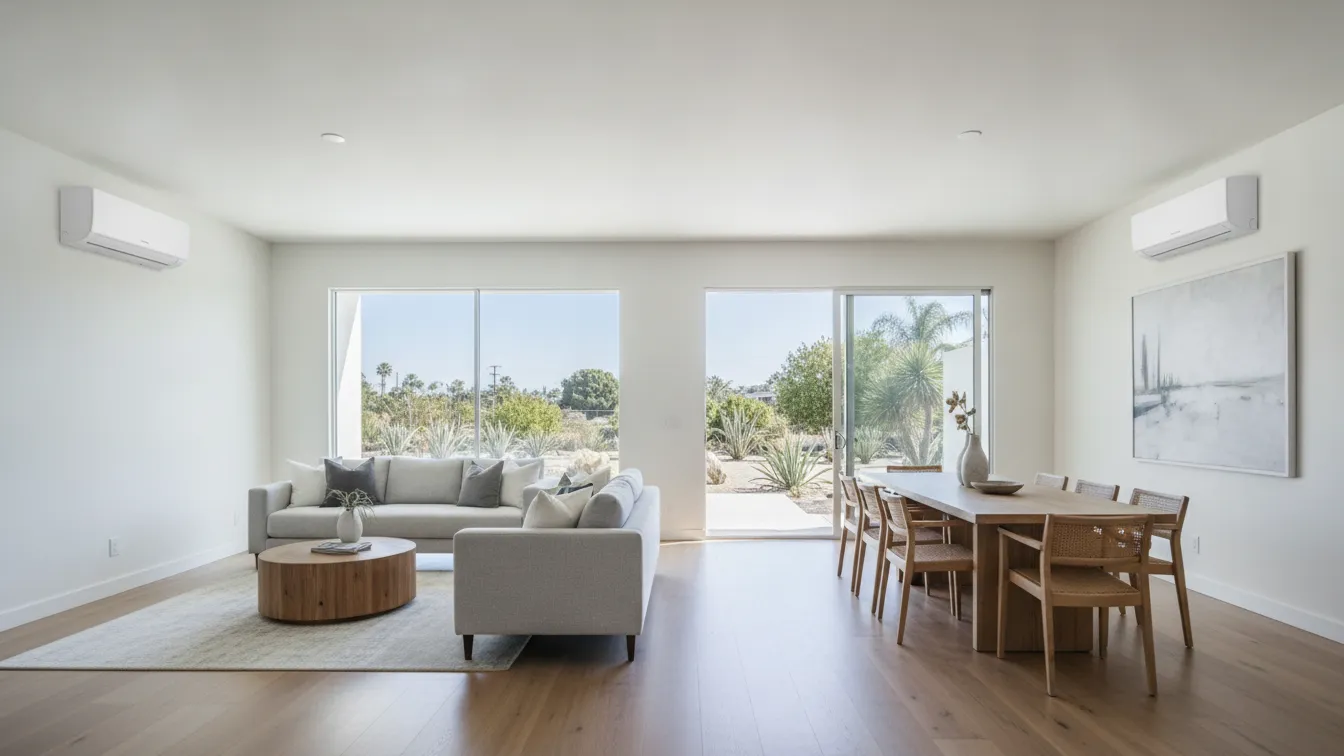
Mini split installation cost
One head in a hot bedroom and a system for the whole house are very different jobs. Here is what decides the price of a ductless install.
Updated September 2026 by the Air Cove HVAC team
A mini split is priced by the rooms it serves, so the first question is how many heads you need.
A ductless mini split has an outdoor unit and one or more indoor units, called heads, mounted on a wall or ceiling. Each head cools and heats the room or open area it sits in. A thin bundle called a line set carries the refrigerant lines, the power cable and the drain between each head and the outdoor unit.
One head on one outdoor unit is called single-zone. Several heads on one outdoor unit is multi-zone. The number of heads drives the equipment, and where they go drives the labor. We cover homes across Los Angeles, and we price each ductless mini split installation after we have walked the house with you.
What moves the price of a mini split
These are the things we look at before we give you a number.
| Factor | What it does to the price |
|---|---|
| Number of heads | Each head is another indoor unit, another line set and another wall opening. |
| Single-zone or multi-zone | One head per outdoor unit is simple. Several heads may share one larger outdoor unit or use more than one. |
| Size of each room | A big living room with high ceilings needs a bigger head than a small bedroom. |
| Line set length | The farther a head is from the outdoor unit, the more line set, and the more time to run it. |
| The route through the house | A head on an outside wall right above the outdoor unit is quick. A head on the far side of the house may need lines through the attic, a closet or a covered channel on the wall. |
| The type of head | Wall heads are the simplest. Ceiling cassettes and slim ducted units hide better and take more work. |
| Electrical | The outdoor unit needs its own circuit and disconnect, and the panel needs room for it. |
| Drainage | Each head drains condensate. Where gravity cannot carry it, a small pump is added. |
Single-zone against multi-zone
The right setup depends on how many rooms you want to control and how the house is laid out.
One room, one head
A single-zone system is the simple answer for one hot bedroom, a home office, a converted garage or an addition the ducts never reached.
Several rooms, one outdoor unit
A multi-zone system runs two or more heads from one outdoor unit. It keeps the side yard tidy, and each room still has its own control.
Several outdoor units
In a larger house, two smaller systems can make the line set runs shorter and keep one side of the house running if the other needs service.
Control room by room
Every head has its own setting, so you cool the rooms you use and leave the rest alone.
Why the answer is different in Los Angeles
Plenty of older Los Angeles homes were built with a wall furnace and no ducts at all. That makes a mini split a natural fit here. It adds cooling without cutting duct runs through plaster walls, and because a mini split is usually a heat pump, it heats in winter too.
The layout of the house matters more than its size. A one-story house with an attic above makes line set routes easy. A two-story house, a hillside home or a unit with no attic access takes more planning, and the route is often where the labor goes.
Installing new heating and cooling equipment usually goes through your city's building department, whether that is the City of Los Angeles, Burbank, Torrance or Thousand Oaks. We handle the permit where one is needed. Mini splits made since 2025 mainly run on the newer refrigerants, R-454B or R-32, and handling any refrigerant needs EPA certification, which is one reason a mini split is not a weekend project.
In the inland valleys, where afternoons run hot, we size the heads for the room's real heat load. A west-facing bedroom in Tarzana needs more cooling than the same room in Santa Monica. Before you buy, check the current rebates at LADWP, SCE or SoCalGas, depending on your utility.
The decision you are making
The real question is usually which rooms need help, and whether a mini split is the right tool for them.
- One or two problem rooms in a house that already has central air: a single head is often the cleanest fix.
- A house with no ducts: a multi-zone system can cool and heat the whole house.
- A house with good ducts and an old system: central air may still be the better value. Our guide to mini split or central air compares the two.
To help you decide, we look at the rooms you use, the sun on each side of the house, the walls and the attic, the electrical panel and where the outdoor unit can sit. Then we give you a price for the layout that fits. When you are ready, our page on ductless mini split installation explains how we plan and install the system.
Mini split cost questions
How much does it cost to have a ductless mini split installed?
It depends on how many heads you need, how far each one is from the outdoor unit, the route for the lines and the electrical work. A single head on an outside wall is the simplest job. A whole-house system with long runs is the biggest. We price your house after we have seen the rooms.
How much does Home Depot charge to install a mini split unit?
Any installer, a big retailer included, prices from the same things: the number of heads, the line set length, the route, the electrical work and the permit. When you compare quotes, check that each one includes the same heads, the full line set, the electrical work and the permit, so you are comparing the same job.
Can one mini split cool a whole house?
One head cools the room or open area it is in. It will not push air down a hallway into closed bedrooms. For a whole house, you need a head in each area you want to control, or a ducted unit if the house has space for short duct runs.
Want a price for a mini split? Tell us which rooms need help.

Plan your mini split
Call us, or send the form and we will call you back to set up a visit anywhere across Los Angeles.