
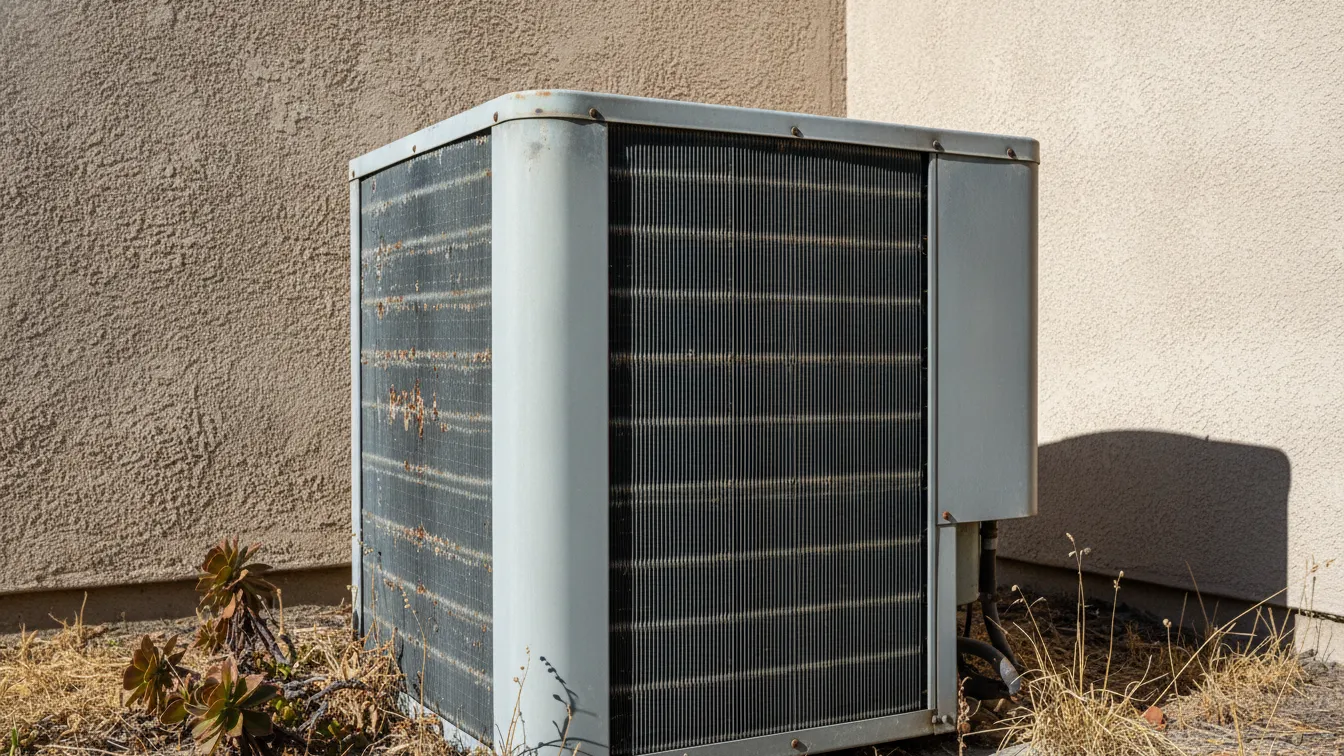
How long an AC unit lasts
An air conditioner does not come with an expiration date, but heat, care and the refrigerant it uses all shorten or stretch its life. Here is what to expect, and the signs it is near the end.
Updated September 2026 by the Air Cove HVAC team
A central air conditioner usually lasts somewhere around fifteen years, and less where it works hardest.
That number is a rough guide, not a rule. A well-sized system that is serviced and runs on sound ducts can go longer. An oversized system that cycles on and off all day, or one that never sees a clean filter, can fail much sooner.
What matters more than the age on the label is how hard the system has worked and how it is holding up now. We can tell you where your system stands after one look. If it is time for a new one, our page on AC installation and replacement explains what that involves.
What shortens an air conditioner's life
These are the things that wear a system out early.
- Heat and long run times. Every hour the compressor runs adds wear. A system that runs all afternoon for months ages faster.
- The wrong size. An oversized system starts and stops too often. An undersized one runs without a break. Both wear it out.
- Dirty filters and coils. They choke airflow, which makes the compressor and fan motors work harder and run hotter.
- Leaky ducts. The system runs longer to make up for cooling lost in the attic.
- Refrigerant leaks. A system running low on refrigerant overheats its compressor.
- Salt air near the coast. Close to the beach, salty air can corrode the outdoor coil over time.
- Skipped maintenance. Worn capacitors and weak motors caught early are small repairs. Left alone, they can take the compressor with them.
Why the answer is different in Los Angeles
The inland valleys work an AC hardest. In Woodland Hills, Sylmar, Santa Clarita, Van Nuys and across the San Fernando Valley, air conditioners carry long, hot afternoons for months each year. More run hours mean more wear, and a system there often reaches the end of its life sooner than the same system near the coast. In Santa Monica or the South Bay, the AC may run far fewer hours, and the thing to watch is the coastal air on the outdoor coil.
The refrigerant change. Most systems installed before 2025 run on R-410A. New equipment made since then mainly uses R-454B or R-32. We can still repair and recharge an R-410A system with R-410A. But on an older R-410A system, a big refrigerant repair is often the point where replacement makes more sense than keeping it going.
Replacement here has steps. When the time comes, a new system needs a mechanical permit from your city's building department and usually an independent Title 24 HERS test of the ducts. Planning a replacement before the old system fails gives you time to price it properly, check rebates at LADWP, SCE or SoCalGas, and avoid choosing on the hottest day of the year.
Signs an air conditioner is near the end
One of these alone may just be a repair. Several together usually mean it is time to plan.
It is past fifteen years
Age alone is not a reason to replace, but an older system is closer to the big failures.
Repairs keep coming
A repair every season adds up, and each one is money spent on an aging machine.
Refrigerant keeps running low
A system that needs refrigerant again and again has a leak, and an older R-410A system is often not worth a major leak repair.
It cannot keep up
It runs all afternoon and the house still will not cool, even after a service.
Power bills keep rising
The house uses more power to stay at the same temperature than it did a few summers ago.
New noises
Grinding, screeching or loud clanking from the outdoor unit can mean a failing compressor or fan motor.
The decision you are making
You are deciding whether to keep repairing the system or plan its replacement. A common rule of thumb helps. Multiply the age of the system by the repair price. If the answer is above 5,000, replacement is usually worth pricing.
We look further than the rule. We check the age, the refrigerant, the compressor, the coil and the ducts, and we ask how well the house cools on the hottest days. Then we tell you plainly whether a repair makes sense, or whether it is time. Our guide to AC repair cost covers which repairs are small and which approach replacement, and our guide to AC replacement cost covers what a new system involves.
Regular AC tune-ups and maintenance are the simplest way to get the most years out of a system. When it is time to replace, our page on AC installation and replacement explains how we size, install and test a new one.
AC lifespan questions
How long do heat pumps last?
A heat pump uses the same parts as an air conditioner, but it runs in winter as well as summer. More run hours mean more wear, so a heat pump often reaches the end of its life a little sooner than an AC that only cools. In the mild Los Angeles winter it works less hard than it would somewhere colder, and good care makes the biggest difference.
Should I replace a 15-year-old AC that still works?
Not just because of its age. If it cools the house, has not needed big repairs and does not leak refrigerant, it can keep running. It is worth planning ahead, though, so a failure on a hot day does not force a rushed choice.
Does maintenance really make an AC last longer?
Yes. Clean coils, a clean filter, the right refrigerant charge and healthy capacitors keep the compressor running cooler and easier. Small worn parts caught early do not get the chance to damage the big ones.
Wondering how much life your system has left? Tell us how old it is and what it is doing.

Find out where your system stands
Call us, or send the form and we will call you back. We work across Los Angeles, seven days a week.