
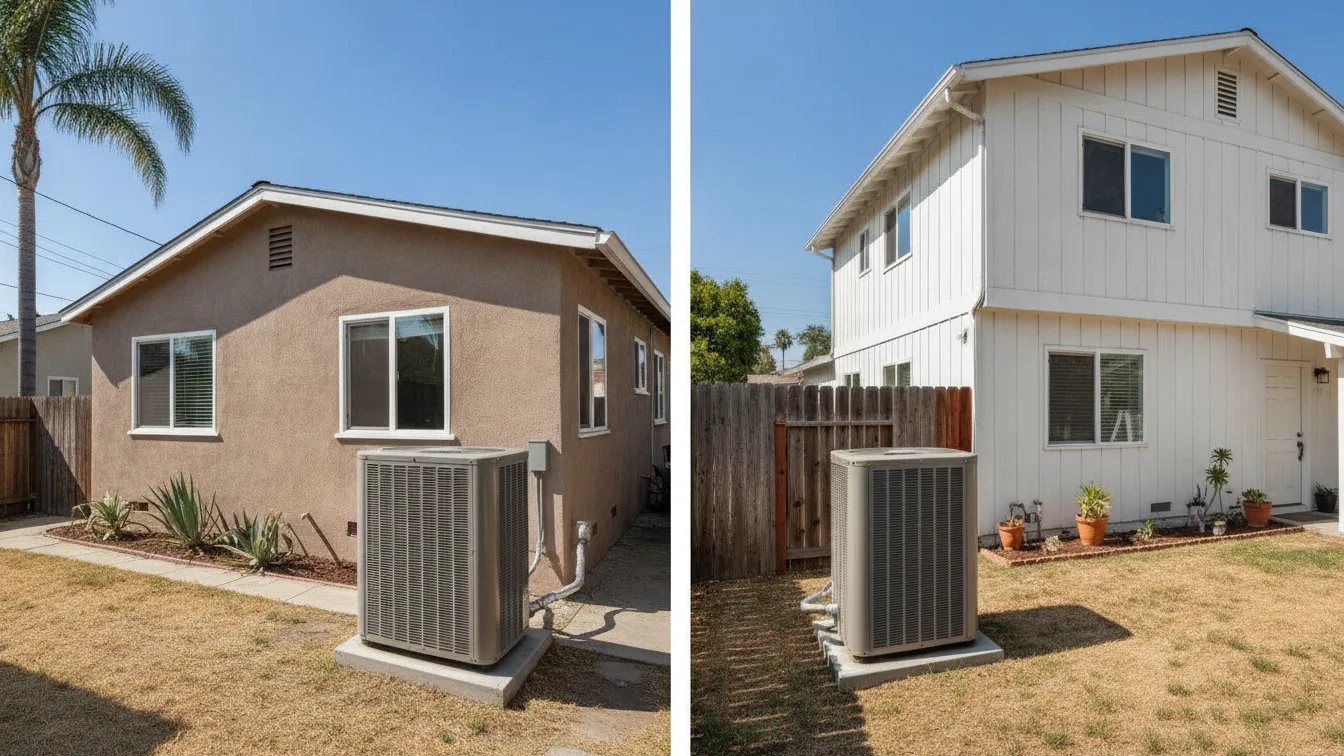
Heat pump or AC for a Los Angeles home
In summer they do the same job. The difference is winter, and in a Los Angeles winter that difference usually decides the choice.
Updated September 2026 by the Air Cove HVAC team
A heat pump is an air conditioner that can also run in reverse to heat the house.
In cooling mode, a heat pump and an air conditioner work the same way. Both pull heat out of the house and release it outside. A heat pump has one extra valve that lets it flip the flow, so in winter it pulls heat from the outdoor air and brings it inside.
So the choice is not really about cooling. It is about how you want to heat the house, and what happens to the gas furnace. We help you make that choice with your house in front of us. Our page on heat pump installation explains how we fit one.
How they compare
Here is how the two line up for a typical Los Angeles house.
| What matters | Heat pump | Air conditioner with a gas furnace |
|---|---|---|
| Cooling | Yes, the same way | Yes |
| Heating | Electric, by moving heat in from outside | Gas, from the furnace |
| Equipment | One outdoor unit and an air handler inside | An outdoor unit and a furnace inside |
| Gas | Not needed | Needed for heat |
| Hours of use | Runs in summer and winter | The AC runs in summer only |
| Best fit | Mild winters, a house moving off gas, a house with no ducts | A house with a sound furnace that is staying on gas |
Why the answer is different in Los Angeles
Mild winters suit a heat pump. A heat pump works best when the outdoor air is cool, not freezing. Los Angeles winters are mild, so a heat pump can usually heat the whole house through the season without help. Across the basin, the Westside and the South Bay, it rarely meets the hard cold that makes heat pumps struggle elsewhere.
The valleys are colder at night. Santa Clarita, Simi Valley and the far end of the San Fernando Valley see colder winter nights than the coast. A properly sized heat pump still handles them. Some homeowners there keep the gas furnace as backup for the coldest nights, which is called a dual-fuel setup.
What happens to the gas furnace. You have three choices. Keep the furnace and add a heat pump in place of the AC, so the heat pump does the heating on most days and the furnace covers the cold snaps. Replace both with a heat pump and an electric air handler, and cap the gas line to the furnace. Or keep the furnace as it is and replace only the AC. We explain what each one means for your house.
Older homes without ducts. Many older Los Angeles homes are heated by a wall furnace with no ducts at all. For those houses, a ductless heat pump adds cooling and replaces the wall heater in one step.
The rules are the same for both. Either change needs a mechanical permit from your city's building department and usually an independent Title 24 HERS test. New equipment made since 2025 mainly runs on R-454B or R-32, whether it is a heat pump or an AC. Before you buy, check the current rebates at LADWP, SCE or SoCalGas. Programs change, so look before you sign.
What we look at to help you choose
We base the recommendation on the house, not on a preference for one kind of equipment.
The furnace
Its age and condition. A young furnace can stay as backup. An old one may be ready to go.
The electrical panel
Moving off gas puts more load on the panel. We check whether it has room.
The ducts
Heat pumps deliver gentler, longer heat, so leaks and undersized ducts matter more.
Where you live
The coast, the basin and the inland valleys have different winter nights.
How you heat
How warm you keep the house and which rooms you use in winter.
Ducted or ductless
Whether the house has ducts worth keeping, or would do better with heads in each room.
The decision you are making
If you are replacing an air conditioner anyway, price a heat pump next to it, because it gives you a second way to heat the house. If the furnace is old too, one heat pump can replace both, and you only go through one permit and one test. If the furnace is young and you are happy on gas, a new AC may be all you need.
To help you choose, we look at the furnace, the panel, the ducts and how you use the house. Then we price the options side by side. Our guide to heat pump installation cost covers what moves the price. When you are ready, our page on heat pump installation explains how we size, install and test the system, and our AC installation and replacement page covers the air conditioner route.
Heat pump or AC questions
Why don't contractors like heat pumps?
Heat pumps earned a poor name in cold climates, where older models struggled on freezing days, and a heat pump that is undersized or installed on leaky ducts will feel weak in any climate. Neither problem is about the heat pump itself. Sized to the house, on sound ducts, a heat pump suits the mild Los Angeles winter well.
Is it okay for a heat pump to run all night in winter?
Yes. A heat pump is built to run long, steady cycles at a lower output, and that is how it heats most efficiently. On colder nights it also runs a short defrost cycle now and then, which can send a little steam off the outdoor unit. That is normal.
Does a heat pump cool as well as an air conditioner?
Yes. In cooling mode it is an air conditioner, and a heat pump sized for the house cools it the same way an AC of the same size would.
Heat pump or AC? Tell us how the house is heated now and we will help you choose.
Choose the right system for your house
Call us, or send the form and we will call you back to set up a visit anywhere across Los Angeles.