
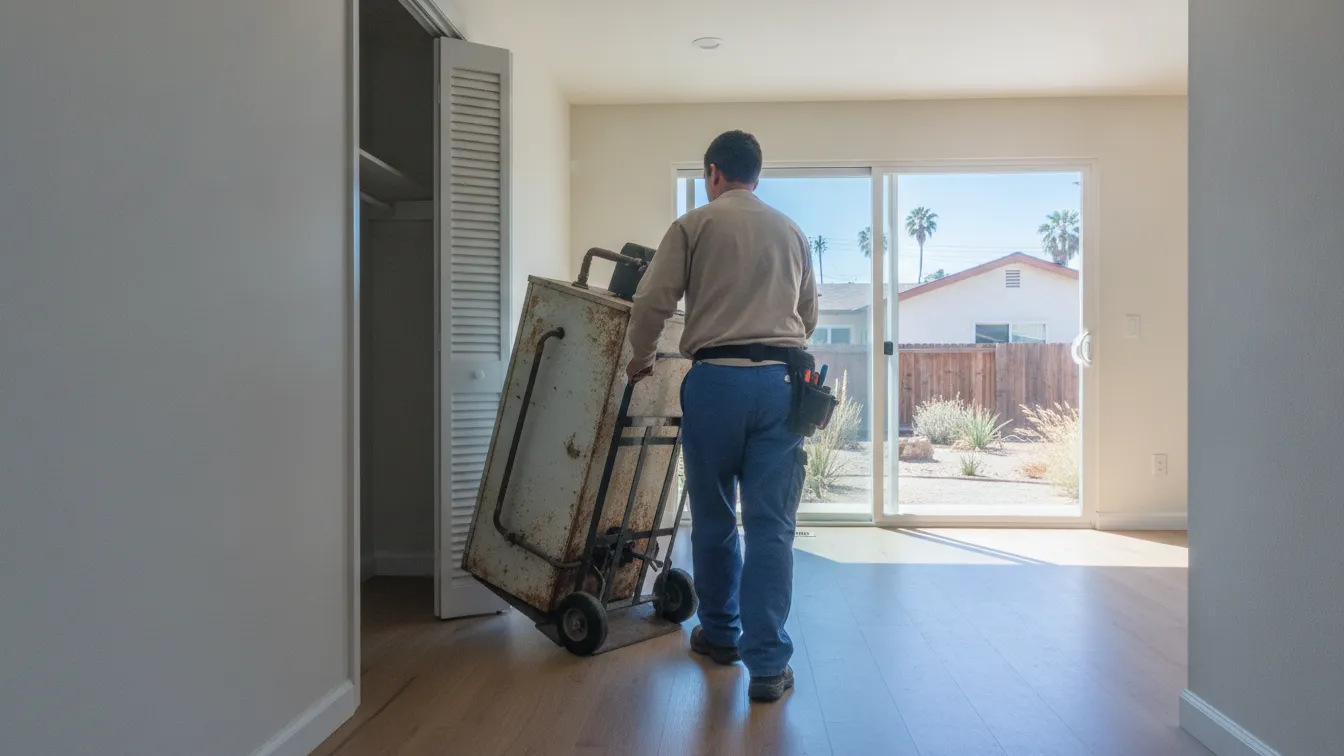
Furnace replacement cost
A furnace in a hall closet and a furnace in a tight attic are different jobs, even when the furnaces match. Here is what decides the price.
Updated September 2026 by the Air Cove HVAC team
A furnace replacement in Los Angeles is priced by where the furnace sits, what it heats and what the ducts it feeds need.
The furnace itself is only part of the price. Getting the old one out and the new one in, venting it safely, connecting the gas and the ducts, and passing the permit and the test are the rest.
That is why two quotes for "the same furnace" can look so different. We price a furnace replacement after we have seen where it sits and what it feeds.
What moves the price of a new furnace
These are the things we look at on the visit.
| Factor | What it does to the price |
|---|---|
| Where the furnace sits | A garage is usually the easiest. A hall closet is close at hand but tight. An attic or a crawl space takes more time and sometimes a different furnace style. |
| Size | A furnace sized to the house heats evenly. We size it from the house, not from the old label. |
| Efficiency | A standard furnace vents through a metal flue. A high-efficiency condensing furnace needs plastic venting and a condensate drain, which can change the install. |
| The venting | An old flue may need replacing or relining to suit the new furnace. |
| The AC coil on top | If the air conditioner shares the furnace, the coil sits on top of it. An old coil may be due at the same time. |
| The ducts it feeds | Ducts that leak or are undersized can add sealing or repair to the job. |
| The gas line | Moving or updating the gas connection adds work. |
| The permit and the Title 24 test | Both belong in a proper replacement quote. |
Why the answer is different in Los Angeles
Older houses, tighter spaces. Many Los Angeles homes are decades old. Furnaces in older houses often sit in small closets, low attics or under the floor, and the space can decide which furnace fits and how long the job takes.
The wall furnace option. Many older homes have no ducted furnace at all. They are heated by a wall furnace, a gas heater set into a wall between rooms. Replacing a wall furnace is its own job, priced by the unit, the venting and the wall opening. Some homeowners replace it like for like. Others use the moment to move to a ductless heat pump that also cools.
The permit and the duct test. Replacing a furnace needs a mechanical permit from your city's building department. In the City of Los Angeles most changeouts go through an express permit. California's Title 24 energy code counts a new furnace as an altered system, so an independent HERS rater usually tests the ducts for leaks after the install. Existing ducts usually need to test at 15 percent leakage or better. Old ducts in older houses are where this test tends to add work, so we check them before we quote.
Rebates to check. SoCalGas, SCE and LADWP each run rebate programs that change over time. Check your utility's current offer before you buy, whether you stay on gas or move to a heat pump.
What we look at before we quote
A good furnace quote comes from a careful look at the whole setup, not just the old unit.
Where it sits
Closet, attic, garage or crawl space, and how the old furnace comes out.
The furnace and the flue
Its age, its size and whether the venting suits a new furnace.
The ducts
Leaks, crushed runs and returns that are too small, since the Title 24 test will check them.
The AC coil
Whether the coil on top of the furnace should be replaced at the same time.
The heat pump option
Whether a heat pump that heats and cools would suit the house better.
The permit
The permit from your city's building department, which we pull as part of the job.
The decision you are making
Before replacement, the real question is often whether the furnace can be repaired. Many furnace repairs are small. An igniter, a flame sensor, a limit switch or a pressure switch are routine fixes. A blower motor or a control board costs more. A cracked heat exchanger is the one that usually ends a furnace's life, because it can let combustion gases into the air you breathe.
If replacement is the answer, the next question is what to replace it with. A new gas furnace, a new wall furnace, or a heat pump that replaces the furnace and the AC together. Our guide to heat pump installation cost covers that route.
To help you decide, we look at the furnace's age and condition, the repair it needs, the ducts, the AC that shares those ducts, and how you want to heat and cool the house for years to come. When you are ready for a number, our page on furnace replacement explains how we remove the old unit, install the new one and test it.
Furnace cost questions
How much should furnace repair cost?
It depends on the part. An igniter, a flame sensor or a limit switch is a small repair. A blower motor or a control board is a bigger one. A cracked heat exchanger usually means replacement. We find the fault and give you the price before any work starts, and we tell you when a repair no longer makes sense.
Should I replace my AC when I replace the furnace?
Not always. If the AC is young and its coil is in good shape, it can stay. If it is old or runs on R-410A with a big repair coming, replacing both together saves a second permit and a second visit. We look at both before we recommend either.
Can I replace a wall furnace with central heat?
Yes, but it means adding ducts, which is a bigger job. A ductless heat pump is often the simpler way to heat and cool a house that has only ever had a wall furnace. We can price both.
Furnace on its last legs? Tell us where it sits and how old it is.
Get a furnace priced for your house
Call us, or send the form and we will call you back to set up a visit anywhere across Los Angeles.